Wednesday, 11 June 2014

Fifteenth Week - Exams are Sobering!

Exams are sobering in two ways. (1) Students don't usually drink in the time leading up to exams... they need to be sober to learn and, more importantly, sober to take the exam! (2) During the semester when content is thrown at us, we feel we're nearly on top of it all, but by the time exams come we realise that we can't quite remember how to do something and the feeling of confidence soon fades away. This feeling is also sobering. However, it's only natural that by the end of the week, having studied hard and downing a few drinks, that we were not feeling sober any more!

PHTY254 practical assessment is worth 15% of the full year paper. Students were given two main questions to demonstrate with five minutes given to each question. We had 10min to prepare equipment (which for me was figuring out how to fix a broken suspension cord) and familiarise ourself with the case study (NB: this is important because the assessor takes the sheet from you while you demonstrate). We had to be competent at all tasks covered in the lab and able to clinically discuss methods taught in the lectures. I had relatively easy questions - phew! I'll list a few examples of students questions, with mine being the first two on the list:

  • Assess right knee flexer weakness for grade two and three using slings and suspension. + Provide an exercise for strengthening at grade three.
  • Assess hip abductor weakness for grades three and four (oxford scale for MMT). + Demonstrate a trendelenburg gait.
  • Teach a 65-year-old with balance issues how to stand from sitting with use of ambulation aids. + Teach walking with the aids.
  • Goniometer measurement of dorsi- and plantarflexion, then demonstrate one stretch for the soleus and gastrocnemius muscles.
  • Use postural drainage for the left lower lobe and perform manual techniques to help clear secretions. 
  • Draw surface markings for the right & left lungs, and the fissures.
  • Demonstrate two ways of measuring thoracic expansion at three levels.
  • Measure FEV1 and FVC (spirometry) then comment on FEV1/ FVC ratio

PHTY251 written exam + the third mastery test MCQ = 64%! We have to pass at least 50% of the written component and achieve more than 50% overall to pass the paper. My advice is to always do the MCQ (if there is one) first - it's a good warm up and may include otherwise forgotten info for the written exam. I felt this exam was pretty good - all the stress and study-torture was worth it.


Did I mention that exams are sobering?? Well, now that my first semester is complete it's time to relax (sleep) and to once again enjoy some fresh air. My third year physio flatmate finished pathology at the same time I finished physiology (her last exam of the semester too), so no doubt we'll share our exam experiences. For many of my cohort year, they will be celebrating together. Essentially, this means a crate drinking competition (alcohol drinking race) between lab groups. 

We have a few weeks of holidays between semesters, so I'll continue this blog when I return! 

Thursday, 5 June 2014

Fourteenth Week: x3 Tsp Coffee Thanks!


I'm not a regular coffee consumer, but the title 'x3 Tsp Coffee Thanks' sums up the general notion that time is quickly diminishing and we need to 'stay awake to study' - coffee is here to help! Sleep helps consolidate information into longer term memory... but it can also lead to realisations that we hadn't learnt anything the day before! At this time, many students reverse their daily routine; get up at night and go to bed in the morning - I don't understand why (but coffee tends to facilitate/accompany this change). Some students get a good nights sleep before the exam, whilst others fear they'll forget info or need to cram more info before the exam and avoid sleep altogether! I liken exams to athletes preparing for a competition/game day (having done a sport science degree and participated in higher level sport at high school, I know this process well). Here is how I liken it to exams:


1. Physical preparation & exam execution.
  •  Nutrition and hydration. The brain is a carbohydrate hungry organ, so feed it complex carbohydrates as per a normal healthy diet. Feel free to snack on fruit for an additional fuel boost. Chocolates and confectionery are nice from time to time - but you will probably find it hard to restrain yourself from eating the whole block/packet at once! Breakfast is important, especially on exam day. Drink water, be hydrated, clear urine is the key. Orchestrate your hydrating and eating so that you don't have to use the toilet during the exam (unless you strategically use it to clear your mind too).
  • Muscle endurance! Written exams are exactly that, written. When was the last time you used a pen and wrote for three hours straight? You need exceptional forearm and hand endurance! You're using underutilised fine motor skills. Good ergonomic posture is helpful too!
  • Prehab: don't go skiing the weekend before exams - you don't want to break any bones!
  • Clothing to the exam. Often exam rooms are cold (or otherwise not optimal for your own specific preference). Bring clothing that can keep you warm, isn't too noisy and that you can remove easily (without distracting anybody else). Also, shirts/jerseys that don't cut your circulation off to your hand when you roll up your sleeve!!
  • In the exam, sit at a desk with minimal distractions and that doesn't rock (all four feet of the desk should be level). 
2. Psychological preparation & exam execution.
  • Know your stuff! There's nothing worse than getting stuck in a rut during an exam. Know everything; use cues to trigger info stored in memory (rhymes, stories about content etc).
  • Know the exam structure, correct exam location/how to get there, time and duration of the exam, weather.
  • Be confident, but modestly so! Expect to see questions that make retrieving particular information hard - know what to do about it! Depending on the exam, people may leave the question and come back to it (or jot down some notes before coming back to finish the question).
  • Be emotionally stable. Don't get in a fight with your lecturer, landlord, power/internet supplier, flatmates, class-mates, family or significant other! Be happy, optimistic and a little bit realistic about your exam outcome expectations. Use relaxation techniques if you need to. Also, be aware of who you're attributing success or failure outcomes to - be in control of your learning.
  • Read and understand the exam question, then answer the question! Use handwriting legibility as an indicator of whether you're writing too fast. If you don't think the examiner can read it, it is time to slow down!
  • If you really don't know the answer to a question, make an educated guess.
  • Check if the instruction page is double sided!!
  • Put your name and ID everywhere that is required!!!
  • When you complete the exam with time to spare or the exam supervisor informs you that you have one minute before the exam finishes, consider drawing a nice picture - preferably something comical, in good taste and relevant to the exam content. Although it won't improve your grade, it makes the mundane task of marking exams less mundane (and as the marker is usually your lecturer - it'll make you a memorable student).
3. Equipment preparation & exam execution.
  • You won't ace an exam with a pen that has run out of ink - so be prepared, have a back up!
  • Every exam requires something different - obtain what you need. Be cautious of the calculator model (if it is required) - it must be university approved.

In case you hadn't realised; this is the first exam week of semester one: we have three written examinations on Wednesday and Thursday morning, and Friday afternoon. Papers on these days are PHTY255 (clinical practice), PHTY250 (anatomy) and PHTY254 (rehabilitation science). As per always, everything is examinable!!
Anatomy notes... good use of strapping tape!!
PHTY255. Lecture and large group clinical content worth 20% of our final paper grade. This exam was in two parts - a case study in each. We were asked about communication, informed consent, reflective practice and subjective assessment. The class was expecting to answer questions about cognitive behaviour therapy or the social problem-solving model! It's good to note that exam questions change from year to year.

PHTY250. Neuro and systems anatomy exam worth 25% of our final paper grade. I'm still on good terms with anatomy having concentrated most of my study to it this week. The exam had eight stations. Twenty minutes was allocated to each station (20 points per question). This exam seemed to drag on, however there was plenty we could write about! Questions were a mix of everything covered in labs and lectures.

PHTY254. Application of scientific principles to clinical practice worth 20% of our final paper grade. Afternoon exams generally mean a sleep-in is allowed that morning (depending on how confident you feel about acing the exam). I felt this exam was my worst of the three this week. There were four sections and a number of questions per section, some had case studies while others were based around clinical tests for different disorders. Leading up to the exam, I thought I would excel in this exam specifically, but upon completion I knew I had left some pretty giant holes in my answers. I felt I went well in the very few case studies presented, but my ability to recall knowledge of particular clinical tests was dismal (and unfortunately, most of the questions asked were like that). This exam, almost exclusively, focused on the 'clinical application' of, rather than the science underpinning physio practice.

Unfortunately much of the time spent studying is coupled with some form of procrastination! Here is how I spend some of my procrastination time...

Ten physio-student commandments.
1. We are not qualified/registered physiotherapists.
2. Our clinical supervisor is superior than us.
3. Thou shall gain informed consent before treating patients.
4. Soup shall not be consumed in clinical uniform.
5. Study, observe, apply, remember.
6. Non-maleficence, beneficence, autonomy & confidentiality.
7. Thou shall always wear name-badge.
8. Thou shall use poker face when patient farts.
9. Thou shall not lift patient.
10. Thou shall wash, sanitise and moisturise hands

Top 10 Procrastination Methods
1. Social Media.
2. YouTube/Movies.
3. Make tasty food, and eat it.
4. Socialise with friends in town.
5. Find paid work, earn $$.
6. Sleeping / Naps.
7. Exercise.
8. TV and gaming.
9. Deface friends study material (naaaa!).
10. Baking, gardening, cleaning, tidying.

Top 10 Productivity Suggestions
1. Make a study plan with daily targets
2. Be interested in course content - be motivated.
3. Practice mock questions, visualisation of material, integration and application of knowledge.
4. Written notes, wall of notes / mind-map, Q&A flip cards with acronyms, rhymes, songs, stories, dances, diagrams, tables, charts, graphs!
5. Study with friends or teach somebody.
6. Routines: Sleep, exercise, eat well, mental preparation and study.
7. Manage stress, appropriately vent frustrations.
8. Study environment: remove distractions, comfortable seat, table, warmth, equipment, natural and artificial lighting.
9. Reward yourself (positive reinforcement).
10. Caffeine.

Top 10 methods that will not help us to absorb content.
1. Sleeping with your notes under your pillow.
2. Burning your notes and inhaling the fumes.
3. Eating your notes.
4. Staring at your notes.
5. Using an open text book as a sun-tanning reflector device.
6. Wearing your notes for clothing.
7. Rubbing your notes on your skin.
8. Using a stethoscope to listen to your notes.
9. Hitting yourself with your notes.
10. Drawing complimentary pictures of  abstract art on your written notes.

Top 10 post-exam note disposal methods
1. Bonfire
2. Gift it to a friend.
3. Scrap paper.
4. Shoot it with a gun (at a firing range).
5. Paper mashe 
6. Throw them in the air
7. Hide them under your bed.
8. 1000 Cranes (origami)
9. Shred them.
10. Paper fight!
(11. extra: bury them with your hopes and dreams.... just kidding!!)
(12. extra, extra: basketball-like shots at the bin + drinking game)

Top 10 things we do that probably has no bearing on actual results.
1. Pray for easy questions
2. Ask people to say "good luck"
3. Ask portraits of paintings of medical professionals (displayed in the exam room) to guide you.
4. Phone a psychic for their prediction on questions
5. Sit between brainy people in the exam, you may be engulfed in their knowledge energy.
6. Good luck underwear!
7. Good luck charm
8. Waiting for someone to incept your dreams (inception)
9. Rituals
10. Practising telepathy.

Next week: one practical exam for PHTY254 (rehabilitation science) and a written exam for PHTY251 (physiology) on Tuesday and Wednesday respectively. These will be the most important exams of the semester to ace!

Wednesday, 28 May 2014

Thirteenth Week - Rapport


Dunedin weather continues to offer four seasons in one day. More wet and cold than sunny and warm at this time of year. We've had hail, snow, gusts and rain over the week. Typical Dunedin rain is misty-drizzle which is ideal for using umbrellas because the rain falls straight down (little/no wind). Last weekend the rain came in thick and fast - two minutes without a rain coat and you may as well go for a dip in the sea with your clothes on (although the rain is not salty!). Not only are 'wets' walking the streets (wet people), they are lying in their flesh for us to examine in our anatomy lab (wet specimens / cadavers). How was that for a topic switch to anatomy?! We finished anatomy for the semester with urogenital and gastrointestinal systems. The lecture on Monday had phrases like "we'll look at the perineal region from the bottom up" (i.e. looking at the inferior surface... this is anatomy humour!). We continue anatomy next semester with the musculoskeletal systems. No doubt the workload will be similar and more hands-on. That's my 10 cents worth in!


PHTY254 continued with chest physiotherapy and associated techniques. Medical imaging is an important role of diagnosis - as such, we must learn how to interpret x-rays. In addition, we were busy percussing chests (a clearance technique this time, not the assessment technique), huffing, coughing, applying manual vibration to the chest and positioning one another for optimal drainage of different branches of the bronchi/passages of the lung. I'm ready for the next wave of the flu now!! The public will be happy that we practice these techniques on fellow students first; the percussion technique uses cusped hands rather than flat 'slaps' - practising on classmates is quality assurance for you! We also learnt the pursed lips breathing technique - you may recognise this as a similar technique ('fish face / kissing face') females use in photos posted on social media! If only they knew how useful it was for persons with COPD. ...no I'm not going to take a 'selfie' of this technique to post here!

My tip for surviving physio is thus, always warm the diaphragm of the stethoscope before touching the patient - nobody likes cold hands either! To maintain good rapport with your classmates, warming your hands before 'patient contact' is essential! (Especially if they've just walked in from the cold outdoors!)

I  found another physio student blog, but this time it is from a past student of the School of Physiotherapy (Otago University): http://mariansphysioblog.wordpress.com/

Today was my last musculoskeletal placement for the year at Dunedin Hospital Outpatient Clinic. The most important thing I have learnt over these three placements is to establish good rapport! From the moment the patient enters the clinic we need to create a positive experience for them. Without this, treatment outcomes are not likely to be as successful. We certainly don't want to make the assessment/treatment process any harder than it has to be - after all, we need to enjoy being physiotherapists!


Dunedin Hospital
With no more lecture slides - it's time to revise! Building rapport with ourselves is important too! We don't have to (but can it we want to) medic in the next few weeks due to up coming exams. The team physiotherapist will cover for us. By the end of next week I would have done three out of five exams - I'll let you know how they go!

A few treatment areas of the Outpatients Clinic
 

Thursday, 22 May 2014

Twelfth Week: Team Work

The kidney filters your blood volume ~30 times every day - that's around 180 litres!

"Think of a hypotonic solution like soup...  but you take out all the salt - which pretty much leaves you with just water..." - A part explanation of the leaky-epithelia working to re-uptake water within the kidney (n.b. urine is not soup!)

Team work was the key to our PHTY254 group presentations on Tuesday. Each group had slightly different aspects of their condition to address, but the idea was to give a 15min presentation on our designated condition / case study. My group was given 'obesity and the metabolic syndrome'. We made the presentation exciting by pretending one member of the group was the client in the case study. I ended up with a pillow under my shirt and a class mate on my back as I preformed part of the Harvard Step Test. In total I was shifting a mass over 140kg to help the class visualise some of the limitations of an obese individual. Other groups presented on osteoporosis, myocardial infarction, multiple sclerosis and diabetes. Recent PHTY254 lectures covered chest physiotherapy, that is; spirometry, reading chest x-rays, reading ECG and chest auscultation (listening to internal chest sounds). We'll get to practice all of these in the labs before the semester break. This week it was just spirometry, percussion (as an assessment technique, rather than a treatment technique), measuring chest expansion (with our hands as well as a measuring tape) and vital signs.

Last week I mentioned that my placement group worked as a team to complete a subjective assessment - this week was no different. Our clinical supervisor is great! If we complete a detailed subjective assessment, she allows us to proceed with an objective assessment and create a treatment plan (all with the patients permission of course) - we are only limited by how efficient and effective we are at the assessment process. Physiotherapists are like investigative journalists or criminal detectives in the way that our subjective assessment works to reveal the specific problem within the context of general health and psychosocial factors. The pathology is usually like a stereotypical criminal; sneaky, deceptive, causes mischief and more often than not needs to be rehabilitated before being allowed to reintegrate back into society. Anyway, we had our notebooks out taking a group subjective again. This week I was given the social history and I done a brilliant job! Only one more week at the Outpatient Clinic to go! Where has the time gone?!

There is a written component to placements. We are expected to complete a SWOT analysis, clinical diary and self-reflection form. SWOT is an acronym for strengths, weaknesses, opportunities and threats. One of these is completed before and after a clinical placement. This encourages us to be self-aware of the above points and plan to minimise weaknesses and overcome threats. Clinical diaries allow us to record conditions we've observed or treated and self-reflection forms allow us to reflect on the experience - these are completed after each day of placement. In addition, the supervisor may ask us to re-familiarise ourselves with content or to research a condition or technique.

I haven't mentioned sport medicing in a while, but this week was particularly exciting (but not because it fits perfectly with the theme 'team work'); the team travelled to Alexandra (2.5h drive from Dunedin) for a match against the Queenstown team! Road trips are always exciting and Alexandra is in a beautiful part of Central Otago, New Zealand! Tech won 9 - 0!!

Thursday, 15 May 2014

Eleventh Week - Placement

We begun a new series of physiology lectures on renal (kidney) function. The lecturer utilised clickers to enhance the learning experience (the yellow remote control-like device, left image). This engaged the audience in a 'game-show' of renal physiology MCQs (multi-choice questions). Rather than announcing individual winners, a poll of submitted responses were shown and the actual answer was highlighted. Good fun!

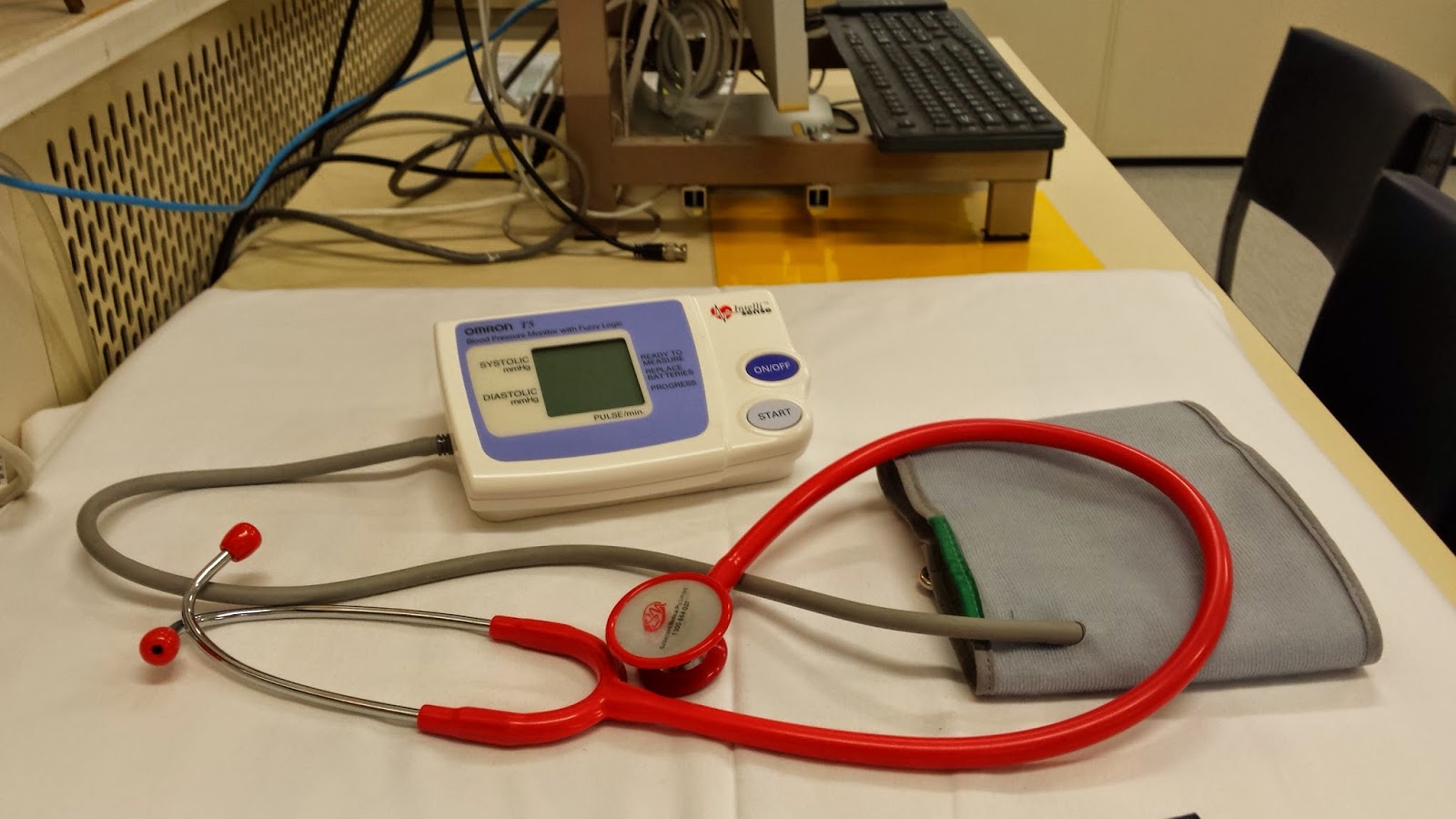
The last physiology lab looked at the electrical and mechanical events of the heart using ECG, pulse transducers, sphygmomanometer (BP meter) and stethoscopes. As you would expect, the events of the heart adapt to different conditions, so we tried a few different conditions (lying vs standing vs exercise) and discussed the mechanisms behind what we observed. In the right hand image, if you look closely you will see some of my own heart electrical rhythms on the screen (the top line is the ECG recording). ECG leads (and electrodes) require accurate 'placement' (positioning) on clients. The imaginary line between the placed electrodes either side of the heart provides information about that particular plane only. This is why a client may have up to 12 leads placed to provide a more complete picture of what is occurring in the heart.

As if we didn't have enough fun with physiology this week, I dusted off my 'exam kit' for our second mastery test on Wednesday evening. This test covered content about: special senses, respiratory, cardiovascular systems and some neural systems content. Thank goodness this was also MCQ.


The staff at the School of Physiotherapy are very friendly and personable people! A few staff even stop to chat when we happen to see each other around Dunedin / the wider community. One of our lab demonstrators from PHTY254 and PHTY250 (anatomy) seems to have successfully memorised most of the students in our year group!!  That's around 100 students, and we are only nearing the end of the first semester - I haven't even said 'hello' to all the students in my year group yet (let alone, know their name by face).

The highlight of my week happened on Thursday - clinical placement! My first physio placement was at the Dunedin Hospital Outpatients Clinic. I have a placement there for the following two weeks too. This is primarily a musculoskeletal service. The placement involved a quick orientation of the physiotherapy outpatient area of the hospital followed by a quick recap of underlying pathology of the knee - and then we had a patient to interview! We were thrown right in to the mix from the get go! As the patient entered the room we were quickly allocated a section of the subjective assessment to take. I was first up. I had to note the 'presenting problem' and fill in the associated body chart. I found this quite difficult, but done an alright job. When I got stuck, my supervisor stepped in to help out. I actually wrote very little on the body chart because I couldn't multi-task. This is certainly something for me to work on next time!!

Tip for surviving physio: have a notebook to document different things you learn/observe, any homework tasks your supervisor gives, and as a resource to notes - like steps of a subjective assessment. Also, it pays to practice assessments on friends and flatmates - physio student's need plenty of 'patient mileage' (practice)!

Hospital staff and health professional students need ID!

There are two more weeks until the end of semester one! (I feel like the count-down has begun). So, here are some more song parody clips, but this time they're from medical students. Although med students will eventually provide a different role in the healthcare service, there is a lot of content overlap and we generally have similar attitudes, workloads and interests. These clips have good entertainment value. Enjoy.


It is hard work being a health science student, but there is always time to positively reflect on their experience and enjoy the process.

Monday, 5 May 2014

Tenth Week: Practice

Practice is the repetition of a task over a period of time and can be used to learn, improve or maintain a current physical or psychological variable. There are many methods to modify how an individual practices - this is important to know as physiotherapy practitioners. Depending on the treatment goal, physiotherapists usually give patients exercises to practice (as a patient, it is wise to adhere to these). Patients may be asked to practice strengthening, motor control, stretching and/or breathing tasks. The phrase 'practice makes perfect' is not always true, but it sure can help. Subsequently, this week a classmate and I practised (on Monday) for a mock exam on Tuesday - the real practical exam will come at the end of semester one. Mock exams enable us to quantify how much and specify what we need to study. The practical exam requires each student to perform one therapeutic task taught in PHTY254. We were not told which task we needed to preform until five minutes before having to demonstrate the task. In that five minutes we need to prepare the equipment and environment. Also in that preparation time, it is important to recall details about the task (because the examiner will scrutinize your method and therapeutic rationale) and to be able to adapt it on the spot if prompted by the examiner (they like to put us on the spot). The assessment must be done professionally, as if it were a clinical situation (...introduce yourself, gain informed consent and thank the patient afterwards, etc). After the mock practical exam, I figured that I was on track and needed to revisit righting reflexes observable in balance examinations. I will have another practice closer to the practical exam.
A classroom used for PHTY254 at the School of Physiotherapy

PHTY254 content took a shift from musculoskeletal techniques to cardiorespiratory. Our lecture and labs covered risk stratification given the presence of risk factors or disease. The lab centred on quantifying body composition, so we were busy pinching each other's fat folds with callipers!! I bet you're imagining what number would come up if you were measured right now. Not to worry, there is a large amount of error when novices measure. In my previous Physical Education (Sport Science) degree, I became certified with the International Society for Kinanthropometry (ISAK) so currently my skill level is still above that of my classmates (but they gave me some nice numbers, which I felt happy with given my current level of physical activity). They'll get better with practice!

My 3rd year physio flatmate also asked for an opportunity for her to practice her manipulation skills on my thoracic spine. It was brought about by a conversation at lunch where she tried to get me to practice my subjective assessment on her. When she hinted that she was keen for a participant to practice manipulation on, I took the opportunity to volunteer and we raced down to the physio clinic lab rooms for her to practice. Apparently there are a few methods to manipulate the spine. Whatever she done, released the nitric oxide, making the popping noise - success!! I felt fine, and we continued separate ways to our own labs that followed. I look forward to learning these skills next year!


Even the skeletons are sociable!
Social events continue to take place. For the next fortnight the annual Otago University Students Association (OUSA) Capping Show is being performed. This is a theatrical production set to offend you and make you laugh. The 2014 theme is 'A Capping Carol: The Night Before Hyde Street'. For those who are not familiar with Hyde Street in Dunedin, it is a common venue for recreational couch burning (usually put out by the fire service and you may be arrested by the police) and once a year it is home to an all day street party for thousands of dressed up students.

Another social event [taking place next week] is the 'Inter-faculty Stein' - this is a health-sciences student organised drinking occasion / night out. Students are encouraged to dress-up in their faculty colours (Dentistry = white, Physio = pink, Pharmacy = green, Medicine = blue) and party! I think I'll pop along to this one!
  
In-class events next week: The second physiology mastery test, our last physiology lab on cardiology and I begin clinical placement next week. I am placed in the outpatient clinic at Dunedin Hospital. There will be plenty to discuss next week!

The faculty event this week was an information day for first year health science students. Physio students and staff were on hand to answer any questions they have about choosing a career in physiotherapy.

My dentistry friend and I made a weekend dash to Wanaka to climb a mountain!!

I've put in some video clips that I have found to be interesting. The first one is on physical activity, the second one is on stress.


That's all for this week... back to the books!!


Wednesday, 30 April 2014

Nineth Week - Respiratory

"At a rate of 70 beats per minute over an average lifetime of 75 years your heart will beat 2,759,400,000 times... you wouldn't think it would make that much difference if it missed just a few..." - Dr Pete Jones, University of Otago.

I'm back from mid-semester one break and feeling pumped, ready to go! 

Whether you believe in creationism, evolutionism or are sitting-on-the-fence-ism, you should agree that the human body is amazing. Sure, there may be a few personalities, political or sociocultural identities that grind your gears, but you must admit that at a body systems level the functioning body is extraordinary. We are all extra-ordinary! Have you ever considered the complexity and thus beauty of the working body? In a healthy body, there are multiple systems working in harmony: respiratory, cardiovascular, endocrine, musculoskeletal, immune and neural. Nearly everything, at the cellular and microscopic level is moving or being moved in a coordinated fashion. It is this movement that we recognise as life. Movement is what makes the world go around!! ... And we were all built to move, so lets move!!

Physical activity is fantastic. At moderate levels it has been shown to reduce the risk of depression, improve self-esteem, minimise the risk of cardiovascular disease, maintain functional activities of daily living, decrease the risk of some cancers, offset the effects of ageing and smoking tobacco. Smoking is an unhealthy habit, and unlike the other conditions listed above, it is a lifestyle decision people find themselves becoming dependent on. Smoking is so unhealthy, that even if you were to be physically active, you would still be at a substantially high risk for all the conditions mentioned above! As health professionals, we must pass a smoking cessation course - this was the highlight of Monday's 8am class. Helping smokers to live healthier lives is as much about lifestyle modification and smoking cessation as it is 'being physically active' alone. There is much to discuss about smoking (like, how it only takes ~6-9 seconds for nicotine to reach the brain, via the respiratory system!); but I would like to end this paragraph emphasising the benefits of a smoke-free lifestyle: reducing the risks of all cause morbidity, improved quality of life, financially better off, not harming those in your immediate surroundings with smoke and smelling better too.

Coincidently, we had our respiratory lab on Tuesday. This involved analysing O2 and CO2 under different conditions - I'll explain. We measured alveolar ventilation using a Haldane-Priestley tube. I searched Google for an image of this device, but found none that resembled what we used in our lab. Basically, it is a clear, plastic tube with a mouth piece and a valve near the mouth piece. A syringe is placed in the valve to suck out expired air. You can actually see part of it being held on the right hand side of the image. We tested the gases after both hypo- and hyperventilation... there were chocolates at stake for the highest measured CO2 in the breath-holding (hypoventilation) task and highest measured O2 in the forced hyperventilation tasks. This made quite a few of us light headed! The lab became even more amusing when we had 'breathing and gym' themed music (e.g. Take My Breath Away, performed by Berlin) playing whilst were were using the Douglas-bags. The Douglas-bag caught all of the air that I expired (breathed out). We compared the ratio of the bulk flow (of air) from rest and after exercise - this [respiratory exchange ratio] relates to the energy substrate (carbohydrate, fat or protein) that is primarily being used. But the main point of the lab was to look at the haemoglobin (Hb) dissociation curve: Hb saturation of a gas plotted against the partial pressure of a gas, namely O2 and CO2. ...All you need to know is that it was a good lab experience.

One PHTY254 lab this week included gait. For a second I thought we were back at primary school because we got to put ink on our feet and stride along a sheet of paper, leaving behind our foot prints!! ...The fun ended when we had to measure distances and angles of the foot, feet and stride patterns. On the subject of primary school... I find it ironic how many concepts use the acronym ABC. It is as if they wish to undermine the complexity of the process by stating it is as simple as learning your 'ABCs' - it's not that simplistic (if it were, we'd all be health professionals). On a positive note, it does have its merits - if you were to have a guess of an acronym that is used to explain something, a good bet would be the ABCs. First aid has its ABCs - Airway, Breathing, Circulation. Neuro has a activity-specific balance confidence scale. Cognitive behaviour therapy's ABCs are Antecedents, Beliefs, Consequences. Athletics trainers use Agility, Balance, Coordination. Smoking cessation practitioners Ask, Briefly explain benefits and offer Cessation support. ABCs for life!!

My subjects at a glance: Anatomy is now focusing on soft and hard tissues/structures associated with the vertebral column. Physiology has just finished covering the cardiovascular system (our cardio lab is in a fortnight). Rehabilitation science is focusing on clinical gait analysis. Clinical Practice was all about passing our smoking cessation 'quit card provider' course - we can now offer discounts on nicotine replacement therapy products, like gum, lozenges and patches.

The human body is amazing - so lets look after it!